
Intro to the next American revolution
Understanding the next great movement waiting to be born


On the anniversary of American independence, we’re starting something new. Common Wisdom is a new monthly publication of Soil & Soul.
Because we’re in the peacemaking business, we’re also doing something a little different. Our first issue is a joint publication, in partnership with Zen Peacemakers International.
Over the past couple of years, Zen Peacemakers has hosted Soil & Soul for two online presentations: Mindfulness with Teens and Secrets of the Civil Rights Movement (including a podcast version). These collaborations are thanks to a shared leader. Francisco “Paco” Lugoviña is board chair for Soil & Soul, and board member for Zen Peacemakers.

A wisdom perspective
Founded in 1994, Zen Peacemakers is over a decade ahead of Soil & Soul, founded in 2007. But parts of our strategy could be interchangeable. For example …
Zen Peacemakers: “Our mission is to realize our oneness and relieve suffering through contemplative social action.”
Soil & Soul: “Our vision is a land transformed: from a land of ignorance, hatred, and greed — to a land of love.”
These are spiritual approaches to social reform. They prioritize thoughts and emotions (the inner life) above resources and actions, even in the political realm. This is in contrast to a material approach. A spiritual approach is an extension of a wisdom perspective: seeing the whole oneness, understanding the mind as the inflection point of almost all human activity, and thus the most significant force in human society.
A wisdom perspective is rare, but it is not unique, and it is not new.
“The revolution was in the minds of the people”
“Since wars begin in the minds of men,” declares the UNESCO Constitution, “it is in the minds of men that the defences of peace must be constructed.” The converse is also true: Since peaceful revolutions begin in the minds of humans, it is in the minds of humans that the commitments to peace must be sown, nurtured, and kept alive.
Of course the American Revolution was not entirely peaceful. But as John Adams said in 1819:
“What do we mean by the revolution? The war? That was no part of the revolution; it was only an effect and consequence of it. The revolution was in the minds of the people.”
Indeed, the American Revolution is usually dated 1765-1789, a span of 24 years. That includes the related war of 8 years (1775-1783), just a third of that time.
So this is what the first six issues of Common Wisdom will do: analyze, from a wisdom perspective, the revolution that took place “in the minds of the people” ~250 years ago on this soil, along with other revolutions before and after that as well.
To that end, every issue of Common Wisdom is guided by a single goal. We the people need a new movement for peace and freedom in the Americas here and now. We believe the best way to meet such a need is to study the most excellent movements of our past, remembering that revolutions are made by human beings.
Peaceful people = peaceful revolution
What kind of person is necessary for a successful revolution? That will be a central part of our inquiry as well.
To begin that process and to end this piece, let us listen to a peaceful revolutionary, one from the last great movement for peace and freedom in this land, the civil rights movement.
In 1959, Diane Nash was one of several college students preparing for revolutionary action. She and her peers were going to integrate lunch counters segregated by race in Nashville, Tennessee.
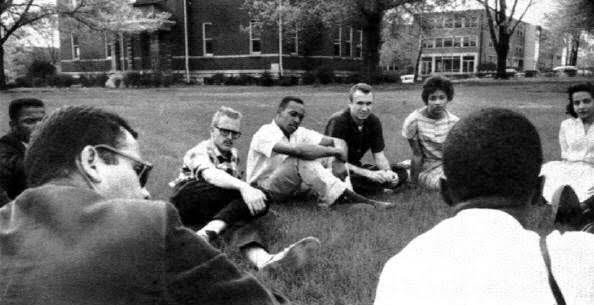
First they studied the philosophy and strategies of nonviolence in weekly workshops run by James Lawson, a minister and conscientious objector who had refused to fight in the Korean War. Then, Nash and her fellow students trained themselves to receive violence at the lunch counters. “I remember we used to role-play,” she recalled in 1985.
“... we would practice things such as how to protect your head from a beating, how to protect each other. If one person was taking a severe beating, we would practice other people putting their bodies in between that person and the violence. So that the violence could be more distributed and hopefully no one would get seriously injured. We would practice not striking back, if someone struck us.”
This gives us a glimpse into the mind and heart — the spirit — of a modern freedom fighter, one who loves peace, justice, and the American way.
A new way of seeing the American Revolution
Here we begin to see elements of a formula and parts of a pattern of peaceful revolution. There is study and preparation — training. And there is sacrifice and change — redemptive suffering. These are some of the elements of a formula, one that applies to the American Revolution as well.
Returning to the events of 250 years ago, what can we say about the American Revolution that has not already been said? From a wisdom perspective, we can start to see it in a new way, and we can see where this new vision leads us.
It was a spiritual movement applied to politics.
It followed a basic formula for social change.
We can apply the same basic formula to our situation, supporting the next great movement for political and social reform on this soil, one waiting to be born.
In sum, what we need is a science of revolution AND a science of spirituality. The most successful revolutions in this country — and there have been several — have been spiritual revolutions. They involve political and social transformations, to be sure. But they were driven by spiritual and cultural changes.
In Common Wisdom, I’m inviting a new reading of the American Revolution as a spiritual revolution, one whose principles have been adopted again and again throughout our history and even across the world. Why wouldn’t we want to reproduce parts of its formula when necessary?
What’s next?
Next time we’ll see if we can discover the formula for peaceful revolution, identifying it in local revolutions — both successful and unsuccessful — and the people who made them.
Plus: Previews of future issues of Common Good …
Understanding the role of spirituality in our revolutions, including The Spirit of ’76
Using the wisdom perspective to see more clearly the politics, social ills, and potential social reforms of today
The never-ending contests between reason and emotion, liberty and responsibility, wealth and poverty and how peaceful revolutions reconcile them
Potential scenarios and actions for overcoming our current political challenges
The strategies and tactics used in previous revolutions and how they apply or don’t apply today
The views and opinions expressed by contributors, authors, guests, or users are their own and do not necessarily reflect the official policy, position, or opinions of Soil & Soul or Zen Peacemakers.